€4.88 – €10.88Preisspanne: €4.88 bis €10.88
What is the A1 ALL in ONE Interior & Glass Cleaner? A ready-to-use interior cleaner from Dr. Wack, set slightly acidic at pH 5.5, that works on glass, screens, dash, fabric, Alcantara, leather and piano black. Not a degreaser for heavy grease films, and no substitute for a dedicated upholstery cleaner.
A1 ALL in ONE Interior & Glass Cleaner is a ready-to-use interior cleaner from Dr. Wack that pulls eight material groups onto a single approval list: glass inside and out, screens, plastic and dash, fabric and upholstery, Alcantara, leather and synthetic leather, paint and piano black, plus vinyl. Nothing gets diluted and there is no dwell time. The cloth does the dosing.
There are six different materials between the steering wheel and the windscreen, and every one of them reacts differently to the same cleaner. An alkaline all-purpose cleaner gets the footwell clean and, over time, eats into the topcoat on a leather seat back. On glass it leaves exactly the haze you set out to wipe off. That is why three bottles stand side by side in so many boots, all-purpose cleaner, glass cleaner and plastic dressing, and why the interior still gets left longer than the paint.
Why one bottle is enough here is on the safety data sheet, not on the front label: pH 5.5 at 20 °C, measured to DIN 19268. That sits slightly on the acidic side, roughly where shower gel is set, and so on the other side of neutral from the alkaline all-purpose cleaners the scene calls APC. For you that means the same bottle that just did the side window can go onto the leather seat bolster without a second thought.
Dr. Wack names two additives outright: an antistatic finish and a built-in odour killer. Antistatic means the ultra-thin layer left behind bleeds off the charge that builds on plastic while you wipe. Without it, a freshly wiped dashboard pulls dust in like a balloon you have just rubbed on your sleeve. Day-to-day: the dash dusts over later instead of straight away. There is no number on the effect, though, since neither the manufacturer’s page nor the data sheet commits to a figure.
Detailing1’s tip from the shop: What we see a lot is Alcantara getting treated like ordinary cloth: spray it on, scrub hard, done. Dr. Wack specifies the opposite for Alcantara, namely straight onto the spot, no dwell time, light pressure, no rubbing. The reason is mechanical: scrub it and the pile of the microfibre suede lies down one way and picks up shiny patches that no cleaner brings back. Work in dabs, turn the cloth often, and lift the pile again at the end by going across it with the dry side.
Three groups of surface, three ways to spray: glass takes the jet, plastic and screens take it via the cloth, fabric gets it spot-on onto the mark.
The bottle wants a shake before the first pull of the trigger, and the nozzle has to be turned from Stop to Spray. For the glass you spray straight onto the pane, clean with a waffle-weave or glass cloth, then run a dry side of the cloth over the already dry pane. That second, dry pass is what decides whether you get streaks, and it is the one people skip most often.
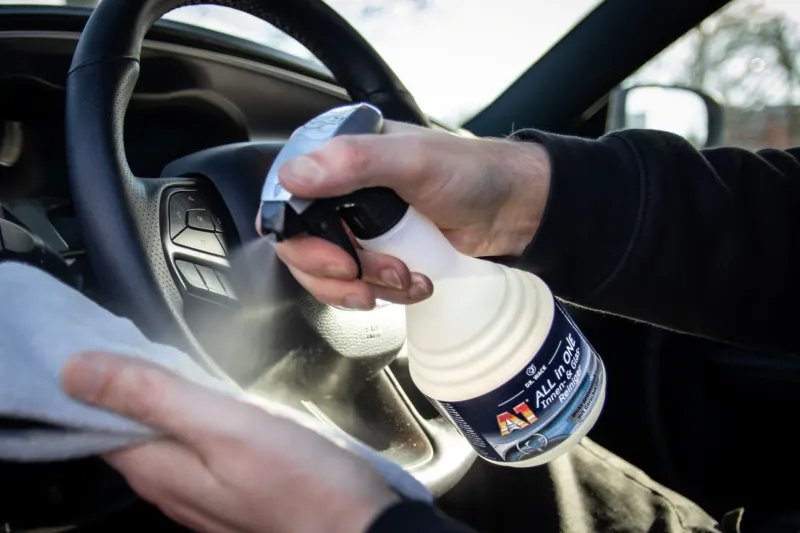
Screens, dash, piano black and painted trim never get the product straight on. There you spray into the microfibre cloth and work the surface with that, following up with a dry side if it needs it. The reason is not the chemistry, it is the seam: overspray that lands on a screen runs into the gap between glass and trim and sits there, where you can no longer reach it.
Fabric, upholstery and Alcantara are the third case. Here the product goes straight onto the dirty spot again, no dwell time and light pressure, because you want the loosened mark to travel up out of the weave into the cloth and not deeper in. On Alcantara the rule from the tip above applies on top of that.
Whether the glass ends up streak-free comes down to the pile and to whatever was in that cloth before. Dr. Wack puts its own microfibre cloth alongside the product, matched to the way it works and with overlocked edges so nothing scratches on screens or piano black. Still keep your cloths sorted by surface: one that has seen plastic dressing carries silicone into the glass and wrecks every dry pass you make.
The order inside the car sounds obvious and still gets done wrong: headliner and dash first, then door cards, then seats, glass last. Start with the windscreen and you wipe it twice, because dusting the dashboard puts dust and overspray straight back onto it.

The cleaner works with no dwell time, and whatever does not go into solution in that second will not come off on the third wipe either.
pH 5.5 is the strength of this product and its limit at the same time. A film of smoke, chip fat or years of hand sweat on the centre console needs an alkaline cleaner that turns the fatty acids into soap and makes them water-soluble. A slightly acidic interior cleaner cannot do that, however many passes you make. If the cloth still comes up brown after the third pass, it is the wrong cleaner and not too little pressure.
The second blind spot is the upholstery. Fresh coffee on a seat comes away cleanly with the Interior & Glass Cleaner. A stain that has sat in the weave for three weeks needs dwell time, foam and a tool with bristles. For that, the same line carries the upholstery and Alcantara cleaner as the specialist. Fresh, take the all-rounder. Dried in, take the specialist.
The third limit sits in the word cleaner. Cleaning and conditioning are two steps, and this product only does the first. On leather it lifts the hand grime off the topcoat but gives back neither suppleness nor protection, and on plastic it leaves no care layer with UV protection. If you want deep black on the dashboard after the wipe, you need a plastic dressing afterwards.
The fourth limit is on the glass. As a glass cleaner the product gets the pane clean and streak-free, it does not seal it. Nothing repels water afterwards, there is no beading and no rain-repellent effect, that is a glass sealant’s job. The approval for outside glass means cleaning: bug splatter that has stood in the sun for two days is still a case for a bug remover.
The fifth limit is not a material limit but a handling one, and it is up in the tip above. That leaves the honest frame: eight material groups, mild chemistry, no heavy lifting. A decathlete does not win the 100 metres, and that is exactly what this product is inside the car.
As an interior cleaner the product earns its place with anyone who does the cabin regularly in one pass and does not want to swap between four bottles while doing it.
It makes less sense if you set aside one deep clean a year. What you are missing then is a vacuum first and a cleaner with dwell time second, not an all-rounder. And if you detail for a living, a concentrate plus your own fabric chemistry gets you further for less.
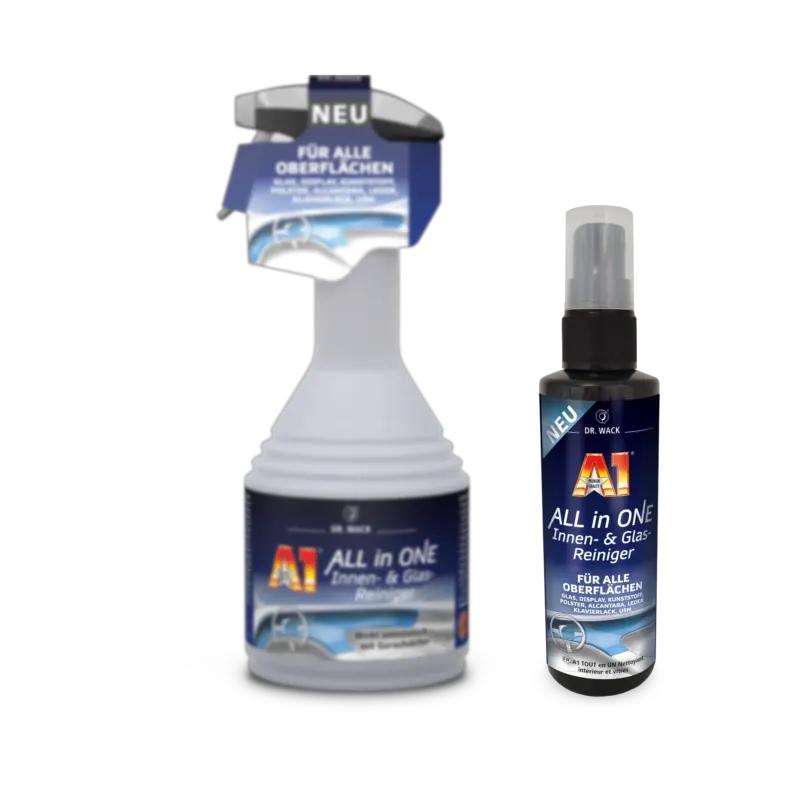
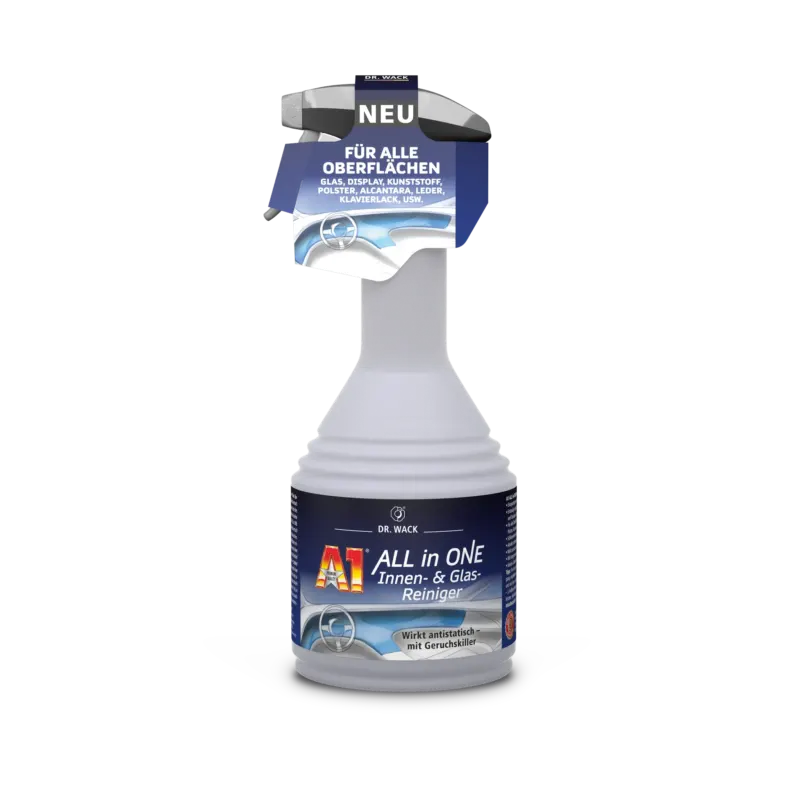
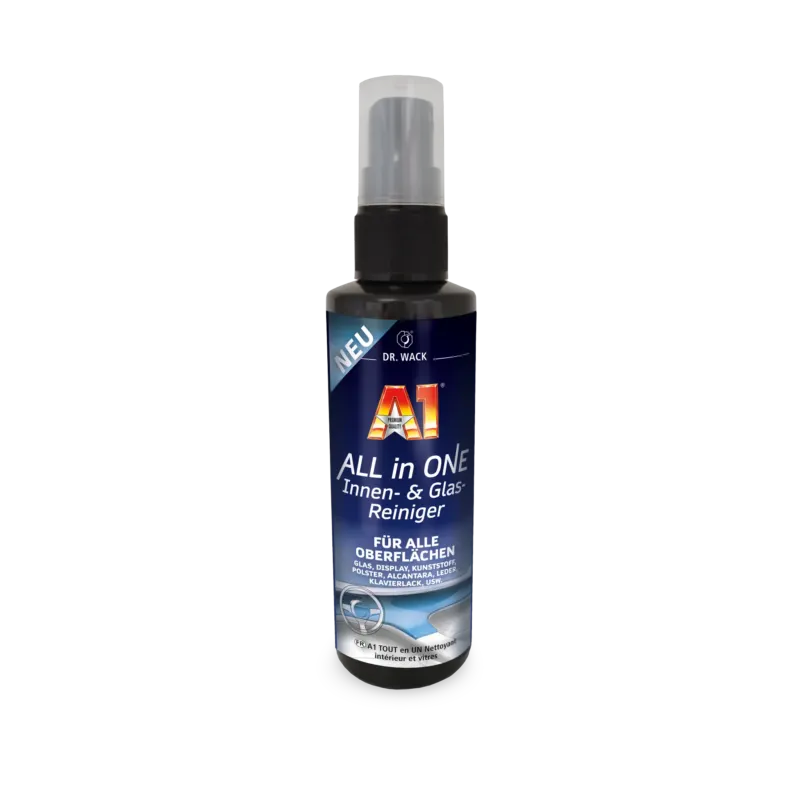
Dr. Wack splits the sizes cleanly. The 500 ml bottle with the trigger head is the version for the shelf, the 750 ml of the Limited Edition 2025 is the same formula with more in it. The safety data sheet for the A1 ALL in ONE Interior & Glass Cleaner lists all three part numbers together. The 100 ml bottle is not a budget version, it is a decision about where it lives: glovebox, company car, fingerprint on the screen before a meeting.
On the shelf the product stands between two camps. On one side the alkaline all-purpose cleaners, which have more power and ask for more care. On the other the specialists for one surface each, from a pure glass cleaner to a fabric foam. What else is lined up next to it is in the interior cleaner category. This product is the answer there to the question about the one bottle.
On storage the safety data sheet says two things: keep it from freezing and store it away from food. So the 100 ml bottle belongs in the glovebox and not in an unheated store room over winter. The product is built in Baar-Ebenhausen, where Dr. Wack has had development, production and logistics on one site since the 2024 new build.
The trick no manufacturer writes down costs nothing and saves you the second lap: wipe the glass horizontally on the inside and vertically on the outside. If a streak is left standing, its direction tells you which side it is on. Horizontal means inside, vertical means outside. Because this product is approved for both sides, you make both passes with the same bottle and do not have to guess while you walk round the car three times.