€39.88 Ursprünglicher Preis war: €39.88€19.88Aktueller Preis ist: €19.88.
What is the iK HC 1.5? A hand pressure sprayer holding 1 litre of usable volume, with seals and components built for oils, hydrocarbon solvents and petroleum products. Not meant for acids, not for many halogenated solvents, and not for brake cleaners with alcohol or acetone in the mix.
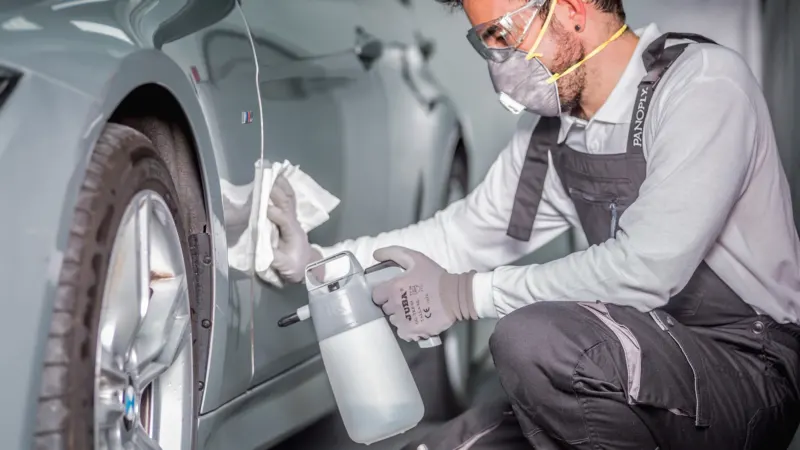
iK Sprayers „iK HC“ 1.5 Druckpumpzerstäuber für Lösungsmittel is a pressure sprayer from Spanish manufacturer Goizper that lets you dose brake cleaner, tar remover, panel wipe and oils straight from the canister. You pump the tank up by hand and a safety valve caps it at 2.5 bar. The adjustable cone nozzle puts out about 0.7 litres per minute according to Goizper.
Detailing1’s tip from the shop: What we see day-to-day is that the mistake which kills most sprayers happens after the job. Leave the last of your brake cleaner sitting under 2.5 bar overnight and you give the piston seal hours to soak itself full. Elastomers swell up like a sponge, the piston goes oversize, and the lever barely moves. That is exactly how the messages reach us: the sprayer looks spotless from the outside, but it will not actuate and it will not spray. So after every job: release the pressure, pour the rest back into the canister, flush it with water, leave it open to dry.
Fill the tank to the 1-litre mark, screw the lid on and pump fifteen times. The safety valve blows off at 2.5 bar, so you cannot overpump it.
The cone nozzle turns steplessly from fine mist to a tight jet. For tar on a sill edge you take the jet and work bottom-up, so the dissolved gunk does not run back over the part you just cleaned. For panel wipe before sealing, the mist is enough, because all you want there is a whisper-thin film and every extra drop shows up later as a streak.
What belongs in the tank is what you would otherwise spray from an aerosol: brake cleaner on a pure hydrocarbon base, tar and adhesive removers, silicone remover before paint prep, panel wipe and thin oils. Buy it by the canister, decant it here, and you work the same chemistry far more precisely, because the spray pattern is not dictated by a propellant.
Pressure drops as you spray, which is true of every hand pressure sprayer. When the jet softens, give it three or four strokes rather than carrying on. The other reason one pass at steady pressure beats two at falling pressure: with solvents it is contact time that does the work, and a broken-up jet flashes off before it reaches the dirt.
Solvent-based products are generally not diluted. What goes into the tank hits the surface exactly as it came out of the canister. That makes the nozzle your real control: open the mist too far and you burn through twice the product on a single door without cleaning any better.
The 13.5 cm lance is part of the accessory range and earns its keep around wheel arches, behind callipers or under trim. You will find more units of the same build in our pressure sprayers.
Goizper lists solvents, oils and petroleum by-products as optimal for the HC, and alkalis and ketones as adequate. Acids appear in neither column, and that is no oversight.
This is exactly where two units that are otherwise hard to tell apart part ways. The iK HC and the iK Multi share the same tank, the same 2.5 bar valve and the same flow rate. The difference sits purely in the seals, and it decides whether your sprayer lasts a year or a season.
UnitOptimal per manufacturerNot intended for „iK HC“ 1.5Solvents, oils, petroleum products, solvent-based productsAcids, many halogenated solvents „iK Multi“ Pro 2Acids, neutral products, disinfectantsSolvents and oils only to a limited degree
If you spray brake cleaner, tar remover or silicone remover, the HC is the right unit. If acidic wheel cleaners or iron removers are going in the tank, you grab the acid-resistant pressure sprayer. And if you mostly work alkaline, with pre-wash or APC, the alkali-resistant pressure sprayer is the one you want.
Goizper names two more limits outright. Many halogenated solvents are ruled out, meaning anything with chlorine or bromine in the molecule such as dichloromethane. And with brake cleaner the formula matters: pure hydrocarbon products are fine, versions carrying alcohol or acetone are not. Ten seconds reading the back of the canister saves the seal.
One more sober number: of 1.5 litres of tank volume, only 1 litre is usable. Work a whole fleet in one go and you will be refilling more often. What we see at Detailing1 again and again is people ordering the wrong model from the iK range, because the units look so alike. The number in the name is tank volume, not fill volume.
The HC starts paying off the moment you buy brake cleaner or tar remover by the canister rather than the can. One litre of fill matches roughly two 500 ml aerosols, and you decide how much goes on.
Run the numbers: after ten fills the purchase price works out at just under 2.90 EUR per litre of spray solution, and it keeps dropping with every fill after that. For detailers degreasing daily that is a matter of weeks. For the keen home detailer who pulls the wheels twice a year and does the arches it is more a matter of years, and the sprayer still wins on dosing control.
The HC makes less sense if you own a single solvent product and buy it ready-mixed in a spray bottle anyway. Then you are paying for flexibility you never use. And if you only work alkaline or only acidic, buy the unit built for that instead of pressing the HC into a job it was not made for.
Same goes for the purely functional case: if twice a year a few bug splats and some brake dust need to go, the can off the shelf is plenty. The HC starts to add up where solvent becomes a working material rather than an emergency fix.
The technical summary: 1.5 litre tank, 1 litre fill, safety valve at 2.5 bar, about 0.7 l/min, 0.46 kg empty. Store it frost-free between 5 and 30 °C and give the moving parts a drop of oil now and then. If you cover bigger areas in one go, the same range runs to 6 and 8 litres.
One thing no manufacturer prints on the packaging: label the sprayer the moment you fill it. We get asked all the time whether a particular product can go in the pump sprayer, and the honest answer nearly always depends on what was in there before.
A unit that has seen silicone remover and then takes panel wipe without a rinse spreads residue across the very panel you are about to seal. The mistake only shows when the sealant dries patchy, and then the whole door is back on the list. One unit, one medium, label on it.