€5.88 – €89.88Preisspanne: €5.88 bis €89.88
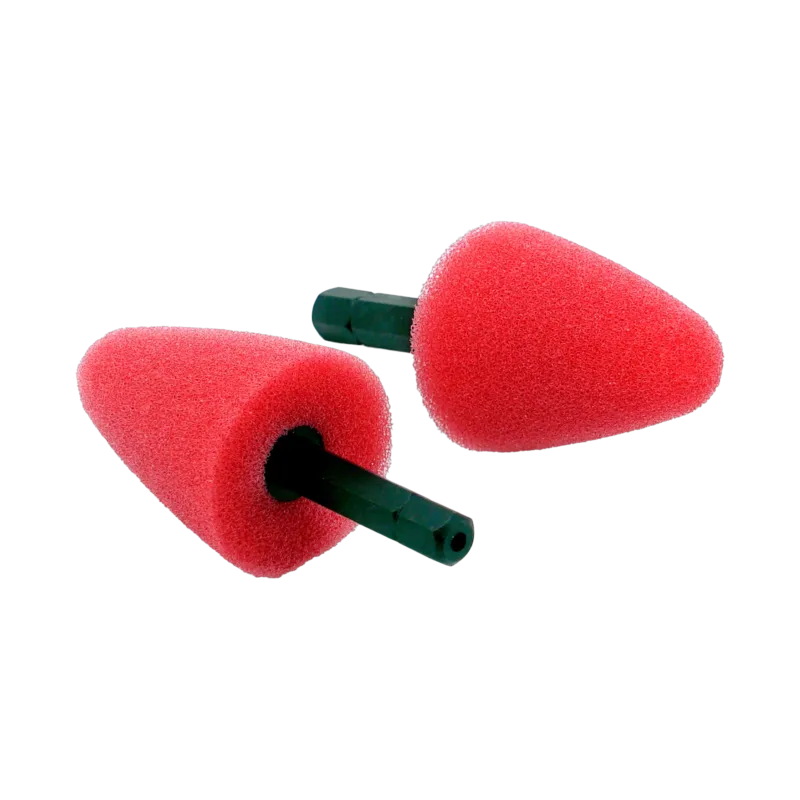
What is the ZviZZer Thermo Cone Pad Hard? A cone-shaped, hard polishing pad in red made from open-cell thermo foam with a hook-and-loop back, whose narrow tip gets into corners, swage lines and mirror triangles. The red hardness gives you strong cut for scratches and holograms in the spots a flat round pad skips. Not for big panels and not for the hologram-free finish.
The ZviZZer Thermo Cone Pad Hard is a cone-shaped, hard polishing pad from ZviZZer made of open-cell thermo foam, marked red for the hard cut step in the five-stage colour system. The conical shape tapers to a narrow tip you use to get at contours, into corners and into tight spots a flat round pad never reaches. The open-cell thermo foam holds its shape better than standard foam under friction heat and keeps the cutting power constant across the whole polishing pass.
Detailing1’s tip from the shop: The most common mistake with a cone pad is leaning too hard on the tip. The small contact patch bundles all the pressure, and on a tight bumper edge we ended up with a dull burn mark instead of correction within seconds. Work with the flank of the cone, keep it moving, and only use the tip to get into the recess. The tip guides, the cut comes from the abrasive in the compound, not from how hard you press.
Drop a pea-sized blob of compound on the flank of the cone, set it down at low speed and then work it out with medium pressure until the polishing film in the recess goes clear.
The Cone Pad runs on the small backing plate of a mini polisher or on a rotary spindle extension. The catch is a clean, washed and decontaminated finish, otherwise a speck of grit in the tight spot drags fine scratches. Pair the hard red step with a strong HC 4000 cutting compound, whose colour in the ZviZZer system matches the red step.
Keep the cone clean: the small face clogs with polishing dust faster than a big pad. After each contour you’ve worked, tap it out or switch to a fresh cone — a clogged cone just smears and builds no cut anymore. Prime fresh pads with a touch of compound before the first run so the open-cell foam takes it up evenly.
The hard Cone Pad is built for tight spots: mirror triangles, vent grilles, swage lines, door-handle recesses and bumper edges all come good with the right cutting compound, but for big panels the cone face is too small.
Its home turf is detail correction where the big pad can’t reach. On a weathered bumper with swage lines the tip works into the recess while the flank takes the neighbouring area along with it. The open-cell structure holds the cutting power at the same level in every tight spot instead of fading off as the polish goes on.
The limits are honest: you don’t polish a bonnet with the cone, the face is too small for that. If you’re refining holograms and gloss in the tight spot, then reach for the softer Thermo Cone Pad Medium in orange with a finer compound. If you’re correcting big panels, then a flat all-rounder or trapezoid pad in the matching hardness. On very soft Japanese clearcoats the bundled tip can overheat fast, so you’re better off working a step softer there.
The hard Thermo Cone Pad is the right call when you’re cutting defects on contours and in corners and want a pad that doesn’t collapse under heat and holds the cut.
Because it runs on a mini machine and rotary, it’s the detail building block of the graduated ZviZZer pad system and part of our polishing pads and sanding sponges. It rounds out the big panel pads rather than replacing them: you do the panel with the flat pad, the edges and recesses afterwards with the cone. That way no swirled strip is left standing on the swage line after the panel has long since gone glossy.
It’s less suited to pure panel work and to gloss lovers who only want to refresh and aren’t cutting defects. Within the Cone range red is the hardest step, with orange below it for medium and yellow for fine cut. If you need to cut harder, you don’t switch to a harder cone but to a bigger flat pad with more contact. The one point most people underrate: pad hardness and polishing grit work together, not against each other. A hard cone with a fine compound gives less cut than you’d expect, a soft one with a coarse compound more than you’d think. Match the hardness to the compound instead of just leaning harder on the tip, and you get more correction and less heat out of a single pass — and that’s exactly what the red step is built for.